Renfrew County Foundation Challenges: The Canadian Shield Factor
Renfrew County sits squarely on the Canadian Shield, one of the oldest geological formations on Earth. While the ancient granite and gneiss bedrock beneath the county provides exceptional structural stability for deep foundations, the ground above it presents unique challenges for residential foundations. The combination of shallow soil over bedrock, dramatic seasonal temperature swings, and pockets of clay-rich soil in the Ottawa River Valley creates conditions that Renfrew County homeowners must understand to protect their properties.
Every spring, as the ground thaws across the county from Pembroke to Barry's Bay and from Deep River to Calabogie, homeowners discover cracks that formed during the winter freeze. Foundation cracks in Renfrew County are rarely random — they follow predictable patterns driven by the region's geology and climate. Understanding these patterns is the first step toward making informed repair decisions.
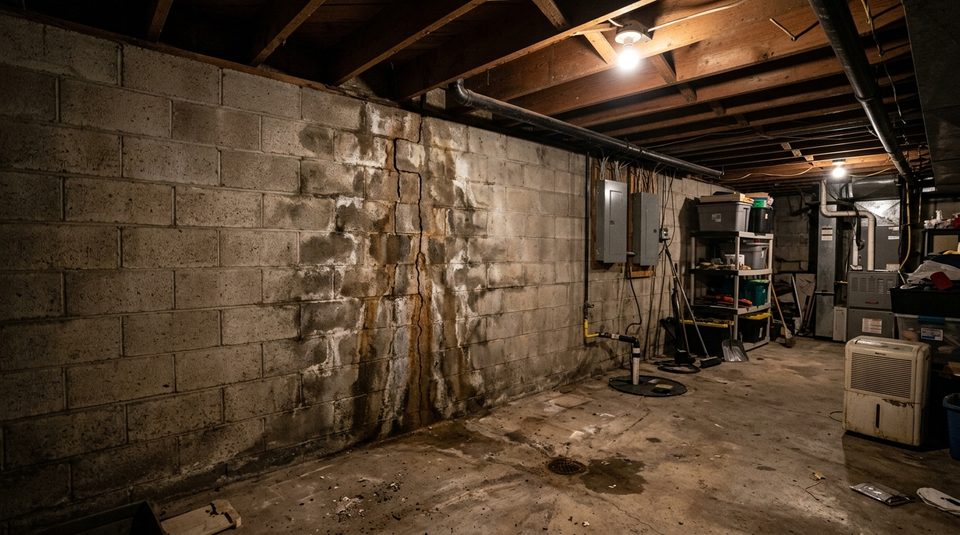
Canadian Shield Geology and Foundation Movement
The Canadian Shield bedrock beneath Renfrew County is predominantly granite, gneiss, and other metamorphic rock that dates back over a billion years. This bedrock is extremely stable and provides excellent bearing capacity for deep foundation systems. However, most residential foundations in the county are built on the soil overburden above this bedrock, not directly on the rock itself.
The depth of soil above bedrock varies dramatically across Renfrew County. In the Ottawa Valley corridor through Arnprior, Renfrew, Cobden, and Pembroke, post-glacial sediments deposited by the Champlain Sea and Ottawa River created deep clay and silt deposits that can exceed 30 metres in some locations. In contrast, areas closer to the Shield in Eganville, Killaloe, Barry's Bay, and the Bancroft area have only thin soil cover of 1–3 metres over bedrock. Each condition creates different foundation risks:
- Deep clay soils (valley areas): Clay expands when wet and shrinks when dry, creating vertical and horizontal pressure on foundation walls. The Ottawa Valley clay belt is known for its high plastic index, meaning it changes volume significantly with moisture content changes.
- Thin soils over bedrock (Shield areas): Shallow frost penetration can reach bedrock, causing ice lenses to form at the soil-bedrock interface. This concentrated frost heave can lift foundation corners, causing diagonal cracking.
- Mixed soil profiles: Many properties in central Renfrew County sit on mixed glacial till where the soil composition varies within a single property, leading to differential movement — one corner of a foundation settles or heaves differently from another.
Freeze-Thaw Cycles and Frost Heave
Renfrew County experiences one of the most aggressive freeze-thaw environments in Southern Ontario. The region typically sees 120–150 frost days per year, with frost penetration depths reaching 1.5 to 2 metres in exposed areas. The freeze-thaw cycle — where temperatures oscillate above and below 0°C — can occur dozens of times in a single late winter or early spring season. Each cycle creates expansion and contraction forces against foundation walls.
Frost heave occurs when moisture in the soil freezes and expands by approximately 9%. But the real damage comes from ice lens formation: as the frost front moves downward, it draws moisture from deeper soil toward the freezing zone through capillary action. This creates layers of ice that can lift foundation elements with enormous force — up to 30,000 pounds per square foot in severe cases. When spring thaw arrives, the ground settles unevenly, leaving foundations stressed and often cracked.
Foundations in Renfrew County most vulnerable to frost heave damage include:
- Shallow foundations built before modern building code requirements for frost protection depth
- Foundations on poorly drained clay soils where moisture content is consistently high
- Foundations without proper perimeter drainage or footing drains
- Sections of foundation near large trees that dried out soil unevenly
- Garage slabs and additions built on separate, shallower footings
Foundation Repair Cost Ranges — Renfrew County, Ontario
The following cost ranges reflect typical pricing for foundation repair work in Renfrew County as of 2026. Actual costs vary significantly by site conditions, crack severity, foundation type (poured concrete, concrete block, stone), and the contractor's accessibility to the work area. Prices are in Canadian dollars.
| Repair Type | Typical Range (CAD) | Notes |
|---|---|---|
| Crack injection (polyurethane) — per crack | $300 – $800 | Active water leaks; flexible seal; up to 2.5 metres crack length |
| Epoxy injection — per crack | $400 – $1,200 | Structural repair; dry cracks; restores wall strength |
| Carbon fibre strap — per strap | $800 – $2,500 | Bowing wall reinforcement; installed per strap section |
| Wall anchor — per anchor | $1,200 – $2,800 | Earth anchor + wall plate for bowing walls; excavation needed |
| Underpinning (mass concrete) — per linear foot | $300 – $600 | Deepening existing footings; engineer-designed required |
| Helical pier — per pier | $1,500 – $4,000 | Deep foundation support to bedrock; per pier installed |
| Interior drainage system + sump pump | $4,000 – $10,000 | Perimeter interior drainage with sump pit and pump; demo included |
| Full exterior waterproofing | $8,000 – $20,000 | Excavation, drainage board, weeping tile, backfill; per wall section |
Common Foundation Issues in Renfrew County
Foundation Cracks
Vertical, horizontal, diagonal, and stair-step cracks each tell a different story about what is happening to your foundation. Learn what each type means and when to take action.
Crack Types GuideCrack Injection & Waterproofing
Polyurethane and epoxy injection are proven methods for sealing cracks and restoring structural integrity without full wall replacement. Learn how each works.
Injection GuideUnderpinning & Stabilization
When foundations settle, underpinning deepens footings to reach stable soil or bedrock. Helical piers, mass concrete, and beam-and-base methods explained.
Underpinning GuideCost & Budgeting Guide
Detailed cost breakdowns for crack injection, carbon fibre straps, underpinning, drainage systems, and full waterproofing for Renfrew County homes.
Cost GuideOntario Building Code and Foundation Repairs
Foundation repairs in Ontario fall under Part 9 of the Ontario Building Code (OBC) for residential buildings and Part 4 for larger structures. Any repair that affects the structural capacity of a foundation — including underpinning, wall replacement, or structural reinforcement — typically requires a building permit and may require engineering design and inspection. Non-structural repairs like cosmetic crack injection without wall reinforcement generally do not require permits, but local municipal building departments in Renfrew County have the final say. View the Ontario Building Code regulations.
Key OBC requirements relevant to foundation repair in Renfrew County:
- Minimum foundation depth of 1.2 metres (4 feet) below grade for frost protection
- Footing width requirements based on soil bearing capacity
- Drainage requirements including weeping tile and granular backfill
- Dampproofing and waterproofing requirements for below-grade walls
Explore More Resources
Regulations Guide
Ontario Building Code requirements, permit rules, engineer involvement, and contractor obligations for foundation work.
Read GuideMaintenance Guide
Seasonal foundation maintenance tailored to Renfrew County's freeze-thaw climate. Protect your foundation year-round.
Read GuideHiring Guide
How to find and vet foundation repair contractors, what to ask, and how to compare quotes confidently.
Read GuideFAQ
Answers to the most common questions about foundation repair costs, causes, and solutions in Renfrew County.
Read FAQ